Kia suspension service is one of those maintenance areas that doesn’t announce itself loudly until something’s actually wrong. Your Kia’s suspension system keeps your car planted to the road, absorbs bumps, and stops your vehicle from bouncing around like a boat in rough water. When it’s working well, you don’t think about it. When it starts to wear, you’ll feel it in almost every drive. Understanding what your suspension does, what signs of trouble look like, and why regular inspection matters can save you from a breakdown and help keep your family safe on the road. At ZP Automotive in Mitchell, we see Kia suspension issues regularly and know exactly what to look for.
Signs Your Kia Suspension Needs Inspection
Don’t wait for a grinding noise or a clunk to get your suspension checked. Here are the real warning signs that bring people into our Mitchell workshop:
- Bouncy or soft feeling when you hit bumps, or the car doesn’t settle quickly after going over a pothole
- Clunking, squeaking, or creaking noises from underneath when turning or going over rough road
- The car leans more than usual when you corner, or feels unstable on bends
- Uneven tyre wear, particularly the inside or outside edges wearing faster than the centre
- The steering feels loose or wanders, especially on straight roads
- One corner of the car looks lower than the others, or the car sits unevenly
- Vibration through the steering wheel or seat when driving at highway speeds
If you notice any of these, your Kia suspension service should include a full diagnostic inspection. Some of these symptoms point directly to wear components like shock absorbers or bushings. Others might indicate alignment issues, worn ball joints, or damaged control arms. Without a proper inspection, you’re guessing.
What Is Your Kia’s Suspension System?
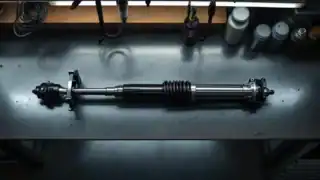
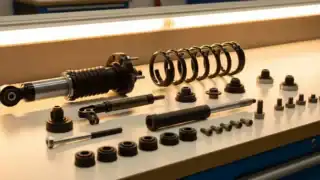
Your suspension isn’t a single part. It’s a collection of components working together: shock absorbers (or struts on many Kias), springs, control arms, anti-roll bars, bushings, and ball joints all work to keep your wheels in contact with the road while absorbing impacts and controlling body movement. Kia’s suspension designs vary across models. Older Kias might have traditional double-wishbone setups, while newer Kias often use strut-type front suspensions and multi-link rear suspensions. The specific layout matters because different components wear at different rates and require different diagnostic approaches.
How We Inspect and Service Your Kia’s Suspension
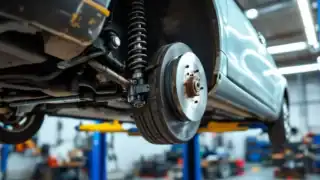
When you bring your Kia in for suspension service, our inspection starts with a lift and a close look at every moving joint and mounting point. We check the shock absorbers or struts by pushing down on each corner of the car and feeling how it rebounds. Worn shocks will bounce multiple times instead of settling with one smooth movement. We inspect control arm bushings for cracks or deterioration, test ball joints for play or looseness, and look at anti-roll bar links and drop links for wear.
We’ll also check your tyre condition and wear pattern, because uneven wear often reveals suspension problems before you feel them. If there’s play in the steering or handling feels vague, we may recommend a wheel alignment check as part of the service. For Kia models with electronic suspension features (some newer Kias include stability control or adaptive suspension settings), we have the diagnostic capability to read error codes and confirm whether sensors or solenoids are contributing to the problem.
Once we’ve identified what needs attention, we’ll explain exactly what we found, show you photos if it helps, and walk you through your options. Sometimes it’s just worn bushings. Sometimes it’s the full shock absorber replacement. If it’s a Kia logbook service requirement, we’ll make sure any suspension work aligns with your manufacturer’s service schedule and keeps your warranty intact.
What Affects Kia Suspension Service Cost and Timeframe
The cost of Kia suspension service depends entirely on what we find. Replacing worn bushings might be a smaller job. Full shock absorber replacement takes longer and costs more. We use quality parts, not the cheapest no-name stock, and we’ll always discuss whether OEM Kia parts or quality equivalent parts make sense for your situation. Parts availability for Kias is generally good, but some models or specific components might need ordering, which adds a day or two to turnaround time.
Labour time varies. A shock absorber replacement on a Kia might take half a day to a full day depending on model and how corroded the bolts are. Control arm or suspension link replacement can take longer. We won’t give you a guess. Once we’ve inspected your car, we’ll tell you exactly what work is needed, roughly how long it’ll take, and what it’ll cost before we start.
Why ZP Automotive for Your Kia Suspension Service
You could take your Kia to a dealership, but you’ll pay dealership labour rates for work that a well-trained independent mechanic can do just as well. Here at ZP Automotive, you’re dealing directly with the mechanic doing the work. There’s no service advisor, no upsell scripts, no pressure to replace parts that don’t need replacing. We’ve been working on Kias and other vehicles for over 10 years, and we see Kia suspensions regularly. We know which components wear predictably on certain models and which symptoms point to specific problems.
We use quality parts and oils (Penrite and Rico are our standards) because they last longer and perform better than budget alternatives. Your Kia’s manufacturer warranty stays intact when you come to us for logbook servicing and scheduled maintenance. And we’ll always be honest about what can wait and what needs doing now. As an owner-operated, family-run workshop, we treat your Kia like it’s our own.
If your Kia is showing any of the suspension warning signs above, or if it’s just time for your scheduled suspension inspection, Claim Your Free Inspection today. Call and Book Now to get your Kia suspension sorted quickly and fairly in Mitchell.