A clutch that’s wearing out or failing will eventually leave you stranded. Land Rover clutch replacement is one of those repairs that catches owners off guard because the clutch doesn’t usually announce itself with warning lights. Instead, you’ll notice the pedal feels spongy, the engine revs without pulling smoothly, or you smell a sharp burning smell when pulling away. If you’re driving in Mitchell or the surrounding areas and your Land Rover isn’t engaging gears cleanly, a worn clutch is likely the culprit. Understanding what’s happening under the bonnet can help you decide whether to act now or risk a more expensive breakdown later.
Signs Your Land Rover Clutch Needs Replacement
The clutch is what connects your engine to the gearbox. When you press the pedal, it disengages the engine from the wheels so you can change gear safely. Over time, the friction material on the clutch disc wears thin. Unlike brake pads, which squeal to warn you, a failing clutch sends more subtle signals.
- Pedal sits lower than it used to or feels spongy under your foot
- Difficulty engaging first gear or reverse, especially from a standstill
- Engine revs climb but the car doesn’t accelerate in proportion
- Burning smell when pulling away or heavy traffic driving
- Groaning or grinding noise when the pedal is fully in
- Slipping sensation, as if the wheels are turning but the engine is just spinning
Land Rovers, particularly the Discovery and Range Rover models, are prone to wear their clutches faster in heavy city driving or towing. If you’ve been doing a lot of stop-start work around Mitchell or pulling loads, your clutch disc may be approaching the end of its life. The longer you ignore these signs, the higher the risk of sudden failure and potential damage to the flywheel or gearbox.
What Happens During a Land Rover Clutch Replacement
Replacing a clutch is a thorough job, not a quick swap. We don’t simply remove the old disc and bolt in a new one. The whole clutch system must be inspected, cleaned, and reassembled correctly to ensure it works smoothly for years ahead.
We start by lifting the vehicle and removing the gearbox. This is where patience and precision matter. Land Rovers have different transmission architectures depending on the model year and engine, so we follow the OEM service schedule specific to your vehicle. Once the gearbox is out, the flywheel is inspected for scoring, cracks, or warping. Many clutch failures are actually caused by a damaged flywheel that wasn’t replaced last time, so we measure and assess it carefully.
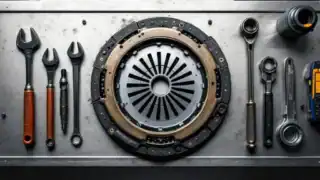
The clutch plate, pressure plate, and release bearing are all replaced as a matched set. We never reuse these components. For Land Rovers, we fit quality parts that match the vehicle’s original specification, ensuring the pedal feel and engagement are exactly as the manufacturer intended. The flywheel is either resurfaced or replaced depending on its condition. The whole assembly is cleaned of any debris, and the release bearing is checked for smooth operation.
Before reassembly, the input shaft is inspected, the pilot bearing is renewed if needed, and the gearbox is refitted using the correct torque settings. We then run through a thorough test to confirm smooth gear changes, proper pedal engagement, and no noise or vibration. This isn’t a service we rush.
What Affects the Cost and Time for Clutch Work
Several factors influence how long the job takes and what you’ll be up for. The most obvious is parts availability. Genuine Land Rover clutch kits are reliable but sometimes need to be ordered. We carry quality equivalent parts from trusted suppliers, which keeps costs fairer without compromising durability. The choice between OEM and quality equivalent parts is yours, and we’ll explain the differences upfront.
Flywheel condition makes a real difference. If it’s serviceable, we resurface it, which saves money and time. If it’s cracked or severely worn, it needs replacing, which adds to the bill. This isn’t something we can know for certain until we’re inside the transmission, so we always contact you before proceeding if additional work is discovered.
Vehicle complexity matters too. Some Land Rover models have easier access to the transmission than others. A modern Discovery will take longer than an older Defender because of additional systems we need to disconnect and reconnect. We always give you a realistic timeframe once we’ve diagnosed the problem, but we never promise a specific completion time until the job is underway and we’ve confirmed what’s actually worn.
Why Land Rover Owners Choose ZP Automotive in Mitchell
We’ve been doing this work for over a decade. The team at ZP Automotive understands Land Rover engines, transmissions, and clutches inside out. We don’t upsell parts you don’t need, and we won’t convince you that the flywheel needs replacing if it’s genuinely fine. You deal directly with the mechanic doing the work, not a service advisor reading from a script.
We fit quality parts such as Penrite fluids and Rico trusted brands, not the cheapest no-name stock that fails again in two years. Your Land Rover deserves parts that match its engineering. We charge fair rates without the dealership markup, and we give you straight advice about what can wait and what needs doing now. If logbook servicing is part of your ownership plan, we keep your manufacturer warranty intact while working on your vehicle.
ZP Automotive also handles wrong-fuel recovery, vehicle lockout and roadside assistance, air conditioning servicing, engine diagnostics, logbook servicing, and ACT rego inspections. Whether you’re in Mitchell for regular maintenance or facing an unexpected clutch issue, we’re equipped to help.
Book Your Land Rover Clutch Replacement in Mitchell
If you’re noticing clutch symptoms or you know your Land Rover is due for this work, Call & Book Now or Claim Your Free Inspection. We’ll diagnose the clutch condition, explain what needs replacing, and give you clear pricing before we start any work.