Japanese vehicles car air conditioning systems are built to tight tolerances and rely on precise refrigerant charge levels, proper airflow through the condenser, and clean cabin filters to function effectively. When your Toyota, Honda, Nissan, Mazda, Mitsubishi, or Subaru’s air con stops blowing cold or cycles on and off unexpectedly, the issue usually traces back to one of a few common failure points specific to Japanese design. At ZP Automotive in Mitchell, our team diagnoses and repairs Japanese vehicles car air conditioning problems using the same methodical approach we’d apply to any other system repair — starting with what you’re actually experiencing, then working through the most likely causes before recommending parts or labour.
Signs Your Japanese Vehicles Air Con Needs Professional Attention
The most obvious symptom is warm or room-temperature air coming from the vents even when the compressor is running. You might hear it kick in and out, but feel no temperature drop. Other signs include:
- A musty or stale smell from the vents, usually caused by mould growth in the cabin evaporator
- Reduced airflow from some or all vents, pointing to a blocked cabin filter or internal restriction
- Compressor engaging and disengaging rapidly (short-cycling), often a sign of low refrigerant or a failing pressure switch
- Visible refrigerant oil leaks around hose connections or the compressor seal
- Fan noise from the condenser fan that sounds strained or laboured
- The air con blows cold briefly, then warm air returns within seconds or minutes
Japanese vehicles tend to show these symptoms clearly because the systems are engineered to be efficient rather than forgiving. A small refrigerant leak that might go unnoticed in a heavier-duty system will quickly drop pressures in a Japanese air con circuit and cause performance to drop off entirely. In the Canberra region, especially during the warmer months, a failing air con system becomes uncomfortable fast, which is why early diagnosis matters.
How We Diagnose and Service Japanese Vehicles Air Conditioning in Mitchell
Our process starts with a visual inspection of the entire air con circuit. We check condenser fins for debris or damage, examine hose connections for signs of oil leakage, and inspect the compressor clutch engagement. For Japanese vehicles specifically, we pay close attention to the receiver drier (the filter cartridge that sits in the liquid line) because blockages here are common and often overlooked by less thorough inspections.
Next, we connect a refrigerant gauging manifold to read system pressures on both the high and low sides. This tells us whether the system is undercharged, overcharged, or has lost all charge. A proper diagnosis also includes checking compressor oil levels, testing the compressor clutch engagement voltage, and confirming that the cabin air filter isn’t restricting airflow. Many Japanese vehicles use climate control modules that are sensitive to refrigerant pressure fluctuations, so we also test sensor responses to ensure the system is communicating correctly.
If we find a refrigerant leak, we use dye injection and ultraviolet light to pinpoint the exact location. Common leak points on Japanese models include the compressor shaft seal, hose crimps at the condenser inlet, and O-ring failures where hoses connect to the accumulator or receiver drier. Once located, we can assess whether a hose replacement, seal repair, or full component replacement is needed.
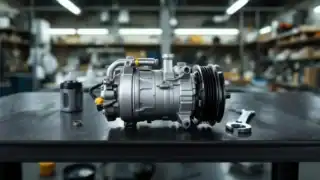
If the issue is a blocked condenser, we may be able to clear it with compressed air and fin straightening. For a faulty compressor, cabin evaporator, or control module, we source quality replacement parts that match the vehicle’s original specification and ensure the system is evacuated and recharged to the correct pressure and oil balance. Japanese air con systems require precision here — overfilling or underfilling the compressor oil can lead to performance loss or compressor damage, so we follow OEM specifications exactly.
What Affects the Cost and Time for Japanese Vehicles Air Conditioning Work
The main variables are the source and severity of the fault. A simple refrigerant top-up and cabin filter replacement takes an hour or two. A full refrigerant system evacuation, leak detection, and recharge takes longer because the system must sit under vacuum for 20 to 30 minutes to ensure no moisture is trapped inside. Any moisture in a sealed air con system can cause corrosion and compressor damage, so this step is non-negotiable for proper Japanese vehicles air conditioning repair.
If parts need replacing, availability depends on whether we source OEM components or quality aftermarket equivalents. Japanese vehicle parts generally have good availability across Mitchell and the broader Canberra region, but some models or older systems may require ordering. Compressor replacement takes longer than a seal repair, and evaporator replacement requires partial dashboard removal on some models. We always confirm what we’ve found and what it will cost before we proceed, so you know exactly where you stand.
Why Owners Choose ZP Automotive for Japanese Vehicles Air Conditioning Repair
You deal directly with the mechanic doing the work, not a service advisor reading from a checklist. We explain what we’ve found, what it’ll cost, and whether it needs fixing now or can wait. We use quality parts and oils, not the cheapest no-name stock, and we source components that match your vehicle’s original specification. With over 10 years in the trade, we’ve seen the common failure patterns across Japanese brands and we know which repairs hold up and which are just temporary fixes.
Our logbook servicing keeps your manufacturer warranty intact, and our transparent pricing means no dealership labour rates and no surprise charges. If your vehicle’s air con system needs more investigation, we offer a free inspection so you know exactly what you’re walking into before committing to work. We’re owner-operated and family-run, which means we treat your car the way we’d treat our own.
Get Your Japanese Vehicles Air Conditioning Inspected and Repaired in Mitchell
If your air con isn’t blowing cold or you’ve noticed any of the warning signs above, call and book now or claim your free inspection. We’ll run through the system properly, find the fault, and give you the straight answer on what’s needed to get your car comfortable again. We’re here in Mitchell, ready to help you with honest, fair-priced air conditioning repair for your Japanese vehicle.