A driveshaft carries engine power through to your wheels, and when it starts to fail, you’ll notice it straight away. European vehicles driveshaft repair in Mitchell addresses one of the most obvious drivetrain issues — vibration, clunking sounds, or a loss of drive that leaves you stranded. Whether you’re driving a Volkswagen, BMW, Mercedes, Audi, or another European brand, a damaged driveshaft demands prompt attention. Ignoring the problem means risking complete loss of power to the wheels and a potentially expensive tow.
Common Signs Your European Driveshaft Needs Inspection
The symptoms of driveshaft failure are hard to miss. Most owners come to us after experiencing one or more of these warning signs:
- Vibration or shaking that increases with speed, particularly noticeable through the steering wheel or chassis
- Loud clunking or banging sounds when accelerating, decelerating, or turning
- A grinding noise from underneath the vehicle, often worse when cornering
- Complete loss of drive with the engine running
- Visible movement or play in the driveshaft when you rock the car in gear
- Grease or oil leaking from driveshaft seals or universal joints
European vehicles, particularly those with independent suspension and multi-piece driveshaft designs, are prone to universal joint wear and centre bearing failure. The vibration problem typically worsens gradually — what starts as a faint buzz can become a severe shake within weeks if the underlying cause isn’t addressed.
What Happens During a Driveshaft Inspection and Repair
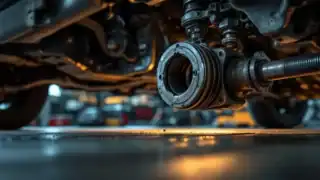
European vehicles driveshaft repair begins with a thorough diagnostic. We lift the car and inspect the entire drivetrain assembly, checking for play in the universal joints, wear on the centre bearing, cracks in the shaft itself, and any damage to the CV joints or constant velocity couplings that many European models use.
For most European brands, we follow OEM inspection protocols specific to your vehicle’s design. BMW’s multi-piece shafts, for instance, have specific runout and play tolerances that differ from Volkswagen Group vehicles. We measure wear using a dial gauge and test joint movement by hand to identify exactly where the problem lies.
Once diagnosed, repair depends on what we find. A worn universal joint might be replaced as part of the shaft assembly, or we may need to replace the entire driveshaft if the damage is widespread. Centre bearing failure requires careful removal and reassembly. We always ensure the replacement shaft meets or exceeds OEM specifications for your model — this matters because European driveshaft designs are often finely tuned to match engine power delivery and suspension geometry.
Before reassembly, we check all mounting points, rubber couplings, and suspension components that could contribute to vibration. A loose engine mount or worn suspension bushing can mimic driveshaft problems, and we address those too so you drive away with a complete fix, not a temporary patch.
What Affects Cost and Repair Time
Several factors influence how long a driveshaft repair takes and what you’ll invest:
Parts availability varies significantly across European brands. Some Volkswagen and Audi driveshafts are readily available through local suppliers; others, particularly for older or less common models, may take longer to source. We’ll discuss this upfront so you’re not surprised by delays.
Shaft design complexity affects labour time. A single-piece shaft is typically quicker to replace than a multi-piece assembly. Some European vehicles require removal of the gearbox or rear axle to access the driveshaft properly, which extends the job.
Associated damage can arise if the driveshaft has been failing for a while. Worn engine or gearbox mounts, damaged suspension bushes, or transmission bearing wear may be revealed during inspection. We’ll explain what we find and prioritise what needs fixing now versus what can wait.
Parts choice — OEM genuine parts, OEM-equivalent aftermarket, or budget options — affects both cost and longevity. We use quality European-spec components that match your vehicle’s engineering standards. We’re not here to fit the cheapest option; we’re here to fit the right part that’ll last.
Why Mitchell Drivers Trust ZP Automotive for European Driveshaft Repair
European vehicles driveshaft repair requires understanding the specific engineering of each brand. Brendan has over 10 years in the trade working on European cars, and he knows the common failure points for each make — where to look, what to check, and how to diagnose accurately.
You deal directly with the mechanic doing the work. There’s no service adviser, no upsell scripts, and no dealership labour rates. We explain what’s wrong, what it’ll cost, and what can wait. If a driveshaft needs replacing, we’ll tell you why and show you the worn parts. If it’s something else causing the vibration, we’ll say so and fix that instead.
We use quality parts and oils — brands like Penrite for fluids and components that meet OEM specifications for your European vehicle. Transparent pricing means you’ll never be surprised by the final bill. And because we’re owner-operated and family-run, we take pride in every job. Your car’s reliability matters to us, not just this week’s turnover.
Our approach to driveshaft repair keeps your vehicle’s service history intact and protects your manufacturer warranty when using OEM-spec parts. We’ve handled logbook servicing for European vehicle owners in Mitchell for years, so we understand the importance of maintaining proper records and using the right components for your specific make and model.
Book Your European Driveshaft Inspection in Mitchell Today
If you’re noticing vibration, clunking, or loss of drive, don’t delay. A failing driveshaft can leave you stranded and cause damage to connected components if ignored. Call & Book Now or Claim Your Free Inspection online — we’ll diagnose the problem and explain your repair options in plain English. Our Mitchell workshop is ready to get you back on the road safely.