Suzuki brake specialist work in Mitchell demands a mechanic who understands how Suzuki systems behave, what parts fail predictably, and how to diagnose problems without throwing unnecessary parts at the car. Your Suzuki’s brakes are critical safety infrastructure, and they deserve someone who knows the platform inside out. We’ve spent over a decade working on brakes across Suzuki’s range, from the Swift and Vitara through to the larger SUVs, and we’ve learned exactly what signs matter and what can wait.
When Do Your Suzuki’s Brakes Need Attention?
Brake problems rarely announce themselves in the same way twice, but there are clear warning signs that bring Suzuki owners into our Mitchell workshop. Listen for what your brakes are telling you.
- A soft or spongy brake pedal that sinks further than usual before resistance kicks in.
- Squealing or squeaking that happens during light braking or when the car sits overnight.
- Grinding sounds under hard braking, which means pad material is worn through to the rotor.
- A brake warning light on the dashboard, whether it’s the pad-wear indicator or a general system fault.
- Pulling to one side when you brake, suggesting uneven pad wear or a caliper issue.
- Brake fluid leaks under the car, visible as dark spots on the driveway or garage floor.
- A noticeably longer stopping distance, even in normal dry conditions.
- Vibration or pulsing through the pedal when braking hard.
Suzuki brake systems are straightforward by design, but that also means problems develop steadily rather than suddenly. A small leak in a caliper seal or a pad wearing unevenly might not trigger the warning light immediately, but it will reduce braking performance over weeks or months. We check for these issues before they force you into an emergency stop.
How We Diagnose and Service Your Suzuki’s Brakes
A proper Suzuki brake specialist doesn’t start with a quote. We start with a physical inspection and honest diagnosis. Here’s what happens when you bring your car in.
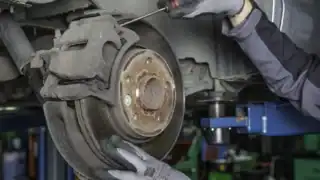
We lift the vehicle safely and remove the wheels to see the brake components directly. Suzuki uses a mix of front disc and rear drum or disc systems depending on the model, and we inspect each one according to Suzuki’s service specifications. We measure pad thickness against the manufacturer’s minimum wear limits, examine rotor condition and run-out to check whether they’re warped, and assess caliper operation and seal integrity on disc systems. On drum brake models, we inspect the shoes, springs, and wheel cylinder performance.
We then test the brake fluid itself. Suzuki’s hydraulic systems are sensitive to moisture contamination and age. If your fluid has absorbed water or degraded, it reduces braking pressure and can damage cylinders internally. We test it with a simple moisture check and advise whether a fluid flush is needed as part of your service.
Finally, we assess your complete braking performance through a test drive, feeling for response, checking for noise or vibration, and confirming that the warning lights behave correctly. For Suzuki models with ABS or electronic brake-force distribution, we scan the system diagnostically to ensure no fault codes are hiding.
Once we’ve identified what needs doing, we explain it plainly. If your pads have 2mm of material left and the rotors are still smooth, we’ll tell you that. If a rotor is damaged and needs replacement alongside the pads, we’ll show you why. If your brake fluid is borderline, we’ll outline the risk and let you decide whether to do it now or in a few months. You’re not sold a service; you’re given honest information and control over what happens next.
What Affects the Cost and Timeline of Brake Work
Brake service cost and time vary based on what we find and what your Suzuki needs. A pad replacement on the front axle is a straightforward two-hour job and far less expensive than a full brake overhaul involving new calipers, rotors, and fluid. If we discover corrosion in a caliper or a leaking wheel cylinder, the repair becomes more involved.
Parts availability matters too. Genuine Suzuki brake pads and rotors are readily available, and we stock quality equivalents from trusted suppliers that meet or exceed OEM specification without the dealership markup. If a caliper needs replacement and we can source a reconditioned unit, your cost drops significantly compared to a brand-new OEM part. We’ll always present your options upfront and explain the differences in durability and warranty.
Older Suzukis or those with high mileage may reveal secondary issues during inspection, such as worn suspension components affecting brake balance or corroded brake lines that need attention. We identify these early so you’re never surprised by additional costs later.
Why Work With Us for Your Suzuki Brake Service in Mitchell
A Suzuki brake specialist at an independent workshop competing against Canberra dealerships and chain mechanics has one advantage: we’re the mechanic doing the work, not a service advisor reading from a script. You deal directly with someone who’s spent years on Suzuki systems, not someone whose job depends on selling you every upsell in the computer.
We use quality parts and fluids. Penrite brake fluid meets Suzuki’s specification and is genuinely better than budget alternatives. OEM-equivalent pads and rotors from established suppliers give you reliability without dealership pricing. Our labour rates are transparent and fair, nowhere near what a dealership charges for the same work.
We also look after your warranty. If your Suzuki is still under manufacturer warranty, logbook servicing through us keeps that protection intact. Suzuki’s warranty explicitly allows independent servicing by qualified mechanics, so choosing us doesn’t void coverage.
Next Steps for Your Suzuki’s Brakes
If you’re experiencing any of the warning signs listed above or it’s simply been longer than you’d like since your brakes were last inspected, book a free inspection with us. We’ll put your Suzuki on the lift, check the system thoroughly, and give you honest advice about what’s needed. Claim Your Free Inspection online or Call & Book Now, and we’ll get your brakes sorted in Mitchell.